
Missouri’s Ancient Lake Dweller
By Arden Fraley, MU Environmental Sciences graduate and Research/Lab Technician at the MU Aquatic Ecology Laboratory
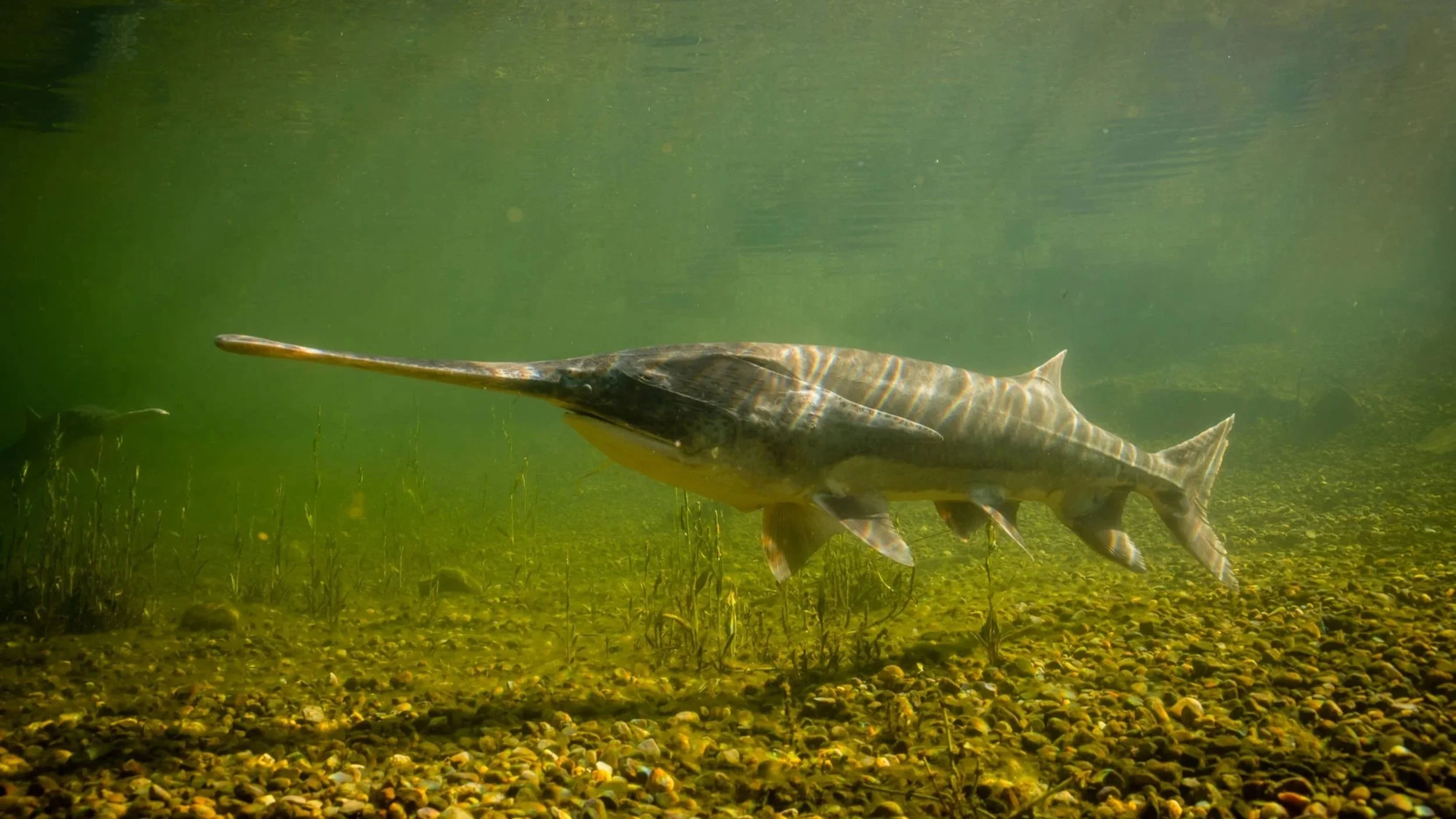
Photo by Ryan Hagerty, USFWS
The American paddlefish (Polyodon spathula) is many things: Missouri’s oldest fish, its official aquatic animal, and an important indicator species for our lakes and rivers. With fossil records of paddlefish relatives dating back nearly 300 million years, this fish has earned the nickname “living fossil”. However, despite surviving for hundreds of millions of years, paddlefish nearly disappeared from many Missouri waterways due to land use changes and declining water quality. Thanks to decades of diligent conservation work, this prehistoric filter-feeder still swims in our waterways today. In return, scientists can gather information from their unique biology and feeding habits that provide valuable insight into changing water conditions.
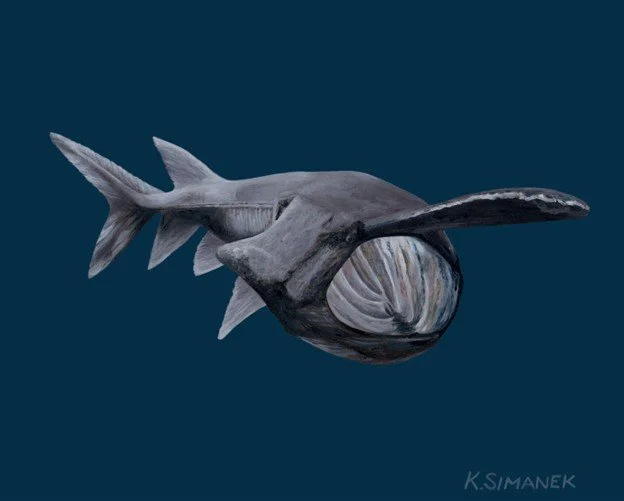
Illustration by Kristin Simanek, USFWS
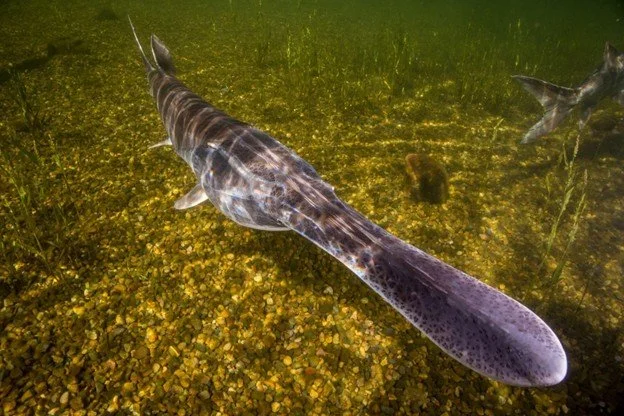
Also known as “spoonbill”, paddlefish are easily recognized by their paddle-like snout (rostrum), which is equipped with electroreceptors that help detect food and navigate murky waters. They also have a wide mouth adapted for filter feeding, similar to basking sharks and whale sharks. Rather than hunting prey, paddlefish slowly swim with their mouths open to strain microorganisms called zooplankton through specialized gill rakers. They have few natural predators due to their large size, typically reaching 5 to 7 feet long and exceeding 100 pounds. They are also cartilaginous, making them appear shark-like. The American paddlefish is the only living paddlefish species in the world, as the Chinese paddlefish is now believed to be extinct.
In Missouri, paddlefish inhabit large reservoirs and slow-flowing rivers where plankton is abundant. They occur in the Missouri and Mississippi Rivers, as well as reservoirs including Lake of the Ozarks, Table Rock Lake, and Harry S. Truman Reservoir. Waterflow alterations in these habitats, along with overfishing and water quality changes, have strained paddlefish populations over the last century.
Conservation History
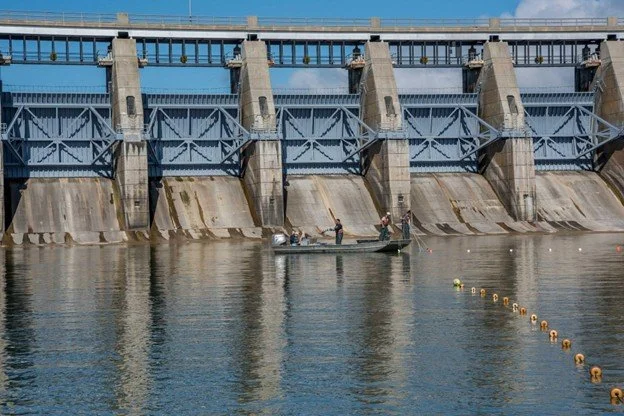
Despite their long evolutionary history, Missouri’s paddlefish population has suffered greatly following altered river flows from dam construction, which dramatically reduced their access to safe spawning grounds.
Conservation efforts at Gavins Point Dam, Brett Billings, USFWS
Paddlefish require specific conditions to ensure the survival of their eggs. During the spring, they migrate upstream to gravel bars during high flow. In addition to providing oxygen, rapid waters ensure that eggs are not suffocated by sand and silt. Following the construction of large dams on Missouri rivers in the 20th century, access to these spawning grounds was gradually blocked. The construction of the Truman Dam in the 1960s significantly contributed to population declines. Becoming confined to the reservoir, paddlefish could only spawn in slow, unfavorable waters. Overfishing also played a large role in their decline. Paddlefish roe is a popular choice for caviar (despite their sale being illegal), and populations were already struggling to maintain their reproductive rate.
Luckily, both federal and state agencies took action to protect American paddlefish in Missouri. In 2013, a two-year undercover operation known as “Operation Roadhouse” involved over 100 Missouri Conservation Agents and U.S. Fish and Wildlife Service agents issuing arrest warrants and gathering information on poachers trafficking paddlefish and selling their eggs. The operation resulted in 125 poaching charges, with some cases still ongoing. The Missouri Department of Conservation also implemented a variety of management strategies for habitat restoration and population monitoring. They implemented regulated harvest seasons to avoid overfishing, and began stocking programs to mitigate spawning issues. Efforts were also taken to drastically reduce invasive zebra mussels, which consume plankton that would otherwise support paddlefish. Today, Missouri supports one of the largest paddlefish populations in the United States, and in 1997 it became Missouri’s official state aquatic animal.
Indicators of Water Quality
Paddlefish habitat requirements and feeding habits render them sensitive to changes in water quality: as a result, they are an excellent indicator species. An indicator species is an organism whose population level provides clues to the health of an ecosystem. Other lake indicator species in Missouri include crayfish, catfish, and even harmful species such as invasive carp and E. coli. Anything sensitive to changing conditions is an early sign that something in the water is amiss.
Unlike other prehistoric fish like gars or sturgeon, paddlefish cannot gulp air at the water's surface. They rely entirely on oxygen dissolved in water to survive. When oxygen levels drop, often due to high temperatures, nutrient pollution, or harmful algal blooms, paddlefish are among the first large fish to experience stress. When dissolved oxygen levels are too low, they can create “dead zones” where aquatic life struggles or fails to survive. Paddlefish populations are easier to monitor than smaller aquatic species, so their disappearance can be an early sign of oxygen-deprived zones.
Their unique feeding strategy also makes paddlefish vulnerable to bioaccumulation pollution. Since they filter large volumes of water to capture microscopic zooplankton, they are constantly exposed to substances dissolved or suspended in water. Contaminants common in runoff such as heavy metals, pesticides, or excess nutrients are easily dissolved in the fatty tissues of paddlefish. Coupled with their long lifespans (30+ years!), this means that one paddlefish can accumulate a high level of toxicity that can transfer to predators like alligators or even humans who consume them. The toxicity of paddlefish tissues can be used to determine the presence of persistent pollutants that are difficult to break down.
On a lighter note, paddlefish are extremely useful for environmental archaeology. The chemical composition of their jaw bones are an archive of chemical signatures, revealing the quality of water that individuals experienced in their life. Elements such as strontium, oxygen, and carbon isotopes preserved in their bones can help scientists reconstruct migration patterns and environmental conditions as the paddlefish grew. This data has important implications for historic water chemistry and river connectivity even decades after the fish lived.
Future of Paddlefish
Although Missouri paddlefish populations have rebounded from their decline, continuous monitoring efforts are needed to ensure their stability and observe their health in relation to water quality changes. The Missouri Department of Conservation currently uses tagging, spawning, and angler surveys to track paddlefish movement and reproductive success. Additionally, about 40,000 baby paddlefish (fingerlings) are released to reservoirs annually to maintain populations in popular recreational snagging areas.
Their reliance on healthy plankton populations, adequate dissolved oxygen levels, and clean spawning habitats means paddlefish success reflects on the overall conditions of their aquatic ecosystems. Protecting water quality through nutrient management and maintaining river systems will ensure that this ancient fish continues to thrive in Missouri.
After 300 million years on Earth, paddlefish still glide through our waters to serve as a reminder of our natural history and a living indicator of health in rivers and lakes.
Ryan Hagerty, USFWS
Read further:
Knight, Joe. “Operation Roadhouse: How Inter-Agency Collaboration Stopped Illegal Paddlefish Depredation.” National Association of Conservation Law Enforcement Chiefs, 17 Sept. 2017, https://naclec.org/press-pages/2017/9/17/operation-roadhouse-how-inter-agency-collaboration-stopped-illegal-paddlefish-depredation
“Paddlefish.” Missouri Department of Conservation, https://mdc.mo.gov/fishing/species/paddlefish.
Pierce II, Robert A., et al. Paddlefish Production: Opportunities for Missouri Pond and Lake Owners. University of Missouri Extension, https://extension.missouri.edu/publications/g9470